We study the feasibility of sub-shot-noise interferometry with imperfect detectors, starting from twin-Fock states and two mode squeezed vacuum states. We derive analytical expressions for the corresponding phase uncertainty. We find that one can achieve phase shift measurements below the standard quantum limit, as long as the losses are smaller than a given threshold, and that the measured phase is close enough to an optimal value. We provide our analytical formulae in a Python package, accessible online.
Figures5
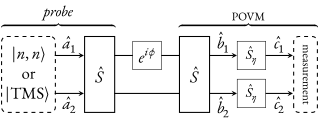
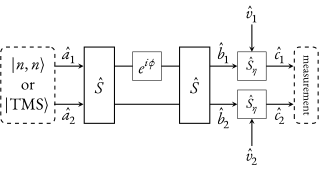
Figure 1.Generic diagram of an interferometry experiment using two-mode pure states at the input modes (a^1,a^2) of the first beam splitter. After the generation of a probing state, a phase shift is applied, and the detection is performed (described by a positive operator valued measure). The 50:50 beam splitter, corresponding to the unitary operator S^ is applied twice, and the phase difference between the two arms is ϕ. The detectors have a finite quantum efficiency η, assumed to be equal, and is modelled with additional beam splitters S^η applied to the output modes of the interferometer (b^1,b^2). The operators c^1 and c^2 represent the modes that are effectively detected.
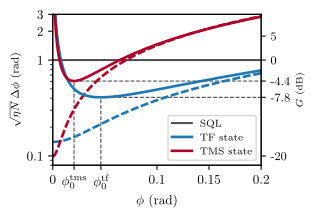
Figure 2.Ratio between the phase uncertainty Δϕ and the SQL, using respectively twin-Fock state (in blue) and two-mode squeezed state (in red) as input states of the interferometer. The dashed lines correspond to the situation where the quantum efficiency of the detectors is assumed to be perfect (η=1), whereas the plain lines refer to detectors with finite quantum efficiency (here η=0.95). Both types of states have an average population of 100 particles (50 per mode). We also give the gain in decibel defined as G=20log(ηNΔϕ).
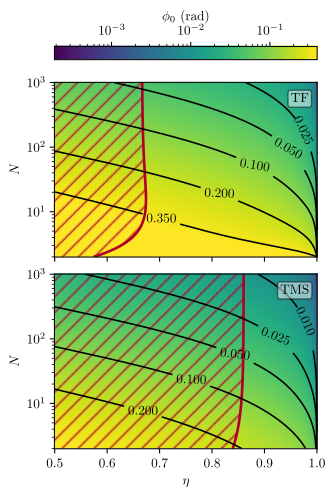
Figure 3.Optimal phase ϕ0 that maximises the phase resolution during a measurement, plotted as a function of the number of particles in the interferometer N and the quantum efficiency of the detectors η. The red hatches exhibit the subdomain of the (η,N) plane where no measurement below the SQL can be performed. Isolines of ϕ0 are plotted in black. The top graph represents ϕ0 for the TF state, while the bottom graph refers to the TMS state.
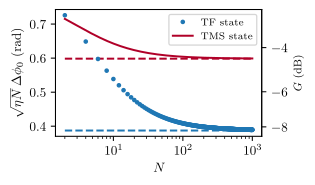
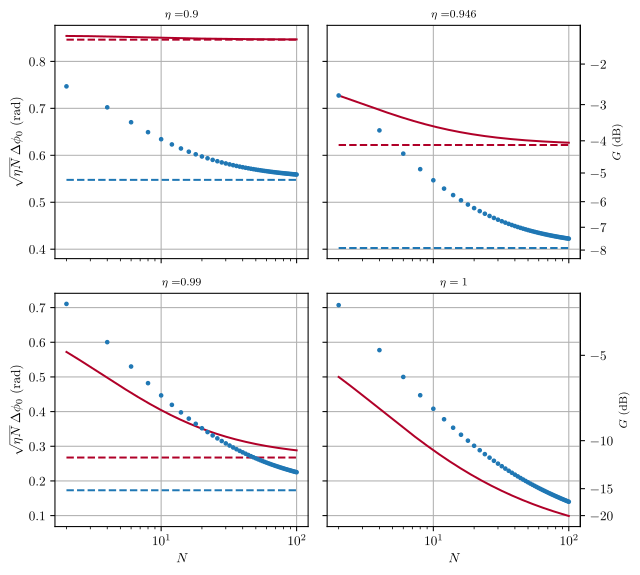
Figure 4.Asymptotic behavior of the ratio between the phase uncertainty Δϕ0 (i.e. Δϕ estimated at the optimal phase ϕ0) and the SQL, as a function of the number of particles, for both TF and TMS states. In the case of TF states, the number of particles N is restricted to even integers. The quantum efficiency is set to η=0.95. The point at N=2 showing a TMS sensitivity better than TF is an illustration of the points made below Eq. (10) that in the lossless case the TMS performs slightly better but that this advantage disappears with decreasing η and increasing N (see the supplemental material). Unlike the lossless case which provides an N−1 scaling, the ratios converge towards a finite limit (dashed line), meaning that the SQL is surpassed only by a constant factor. We also give the gain in decibel defined as G=20log(ηNΔϕ0).
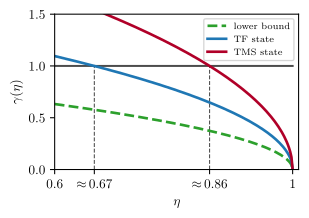
Figure 5.Ratio between the phase uncertainty Δϕ0 and the SQL, in the asymptotic regime, as a function of the quantum efficiency (cf. Eq. (11)). We find that both TF and TMS states give a profile which is proportional to the one obtained with an optimized input state (green dashed line). We also see in this graph the minimal values of η leading to sub-shot-noise measurements (these values correspond to the limit N→∞ of the red lines in Fig. 3).
Figure S1.Scheme of the interferometer that we study. a^1 and a^2 are the input modes, 50:50 beam splitters, corresponding to the unitary operator S^ are applied twice, and the phase difference between the two arms is ϕ. The detectors placed at the output ports have a finite quantum efficiency η, assumed to be the same, and that is modelled with additional beam splitters S^η applied to the output modes of the interferometer (b^1,b^2). The operators c^1 and c^2 represent the modes that are effectively detected. The modes v^1 and v^2 represent the vacuum channels.
Figure S2.Asymptotic behaviour of the ratio between the phase uncertainty Δϕ0 (i.e. Δϕ estimated at the optimal phase ϕ0) and the SQL, as a function of the number of particles, for both TF (blue points) and TMS states (red lines), for various quantum efficiencies. We also give the gain in decibel defined as G=20log(ηNΔϕ0).
We have shown that two classes of experimentally accessible states,
twin-Fock and two-mode squeezed states can behave in a way reminiscent of
ideal ones with respect to their phase sensitivity in interferometers. In
the absence of any loss, their phase sensitivity exhibits
O(N−1) scaling, as do NOON states. On the other hand, in the
presence of loss, they are more robust than NOON states. Although the
sensitivity scales only as O(N−1/2) they can still surpass
the standard quantum limit if the losses are kept small enough. In this
sense they resemble other ideal states which have been shown to be optimal
in the presence of loss, only differing from the optimal states by a
numerical factor, see Eq. (13). We show in Fig. 4 that using a twin-Fock
state and a 95% quantum efficiency results in a 8 dB improvement compared
to the standard quantum limit which is not very far from the theoretical
bound of 13 dB given by Eq. (13). For a two-mode squeezed state the gain is
only 4.4 dB.
We emphasize that minimizing the loss is critical. Fig. 5 shows that both
types of state require a minimum quantum efficiency to achieve a gain.
Fig. 3 shows that this minimum is roughly independent of the number of
particles on that state. Despite this drawback, we expect that such
improvements could be useful in some interferometers: for example when
increasing the number of particles to reduce the shot noise is not
practical. Whether twin Fock or two-mode squeezed states constitute a real
advantage compared to spin squeezing will require more work in the future
using comparisons in realistic experimental situations. The fact that these
relatively accessible states are not far from the optimized ones is an
encouraging sign.
Our analytical formulae are provided in the supplementary materials and are
implemented in a Python package, accessible online at
qsipy.