Parametric pair production of collective excitations in a Bose–Einstein condensate
V. Gondret, R. Dias, C. Lamirault, L. Camier, A. Micheli, C. Leprince, Q. Marolleau, S. Robertson, D. Boiron, C. I. Westbrook
Comptes Rendus Physique (2025) · 10.5802/crphys.266 · arXiv:2508.01654 · PDF
Download .bib PDF in open access
Abstract
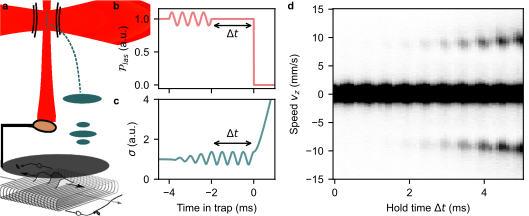
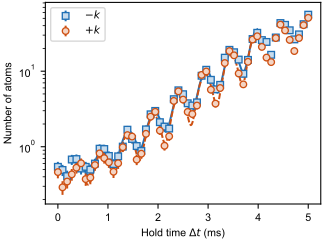
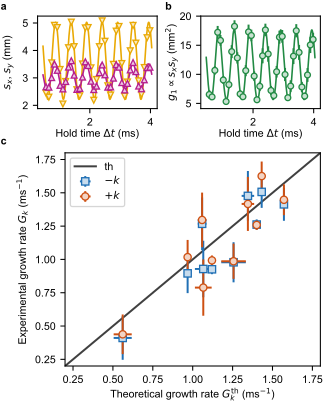
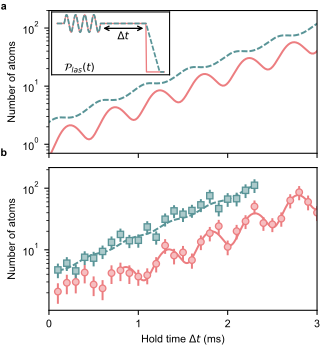
By exciting the transverse breathing mode of an elongated Bose-Einstein condensate, we parametrically produce longitudinal collective excitations in a pairwise manner. This process also referred to as Faraday wave generation, can be seen as an analog to cosmological particle production. Building upon single particle detection, we investigate the early time dynamics of the exponential growth and compare our observations with a Bogoliubov description. The growth rate we observe experimentally is in very good agreement with theoretical predictions, demonstrating the validity of the Bogoliubov description and thereby confirming the smallness of quasiparticle interactions in such an elongated gas. We also discuss the presence of oscillations in the atom number, which are due to pair correlations and to the rate at which interactions are switched off.
Figures4
Conclusion
In this paper, we have studied the production of quasiparticles in a parametrically driven BEC. Our observations of exponential growth and oscillation of the particle number are in agreement with Bogoliubov theory as applied in previous work. The data clearly shows the parametric nature of the process and the fact that the excitations are generated in a pairwise manner.
The measured growth rate is in very good agreement with the predicted value, even in the presence of a trap inhomogeneity. The precision of our measurements cannot isolate and measure the small effect of quasiparticle interactions, which should reduce the growth rate. Nevertheless, our results do confirm the smallness of this decay, if present. Future work will aim to improve the experimental procedure in order to increase the signal-to-noise ratio and further isolate this effect. Higher experimental precision may require a closer correspondence between the experiment and the model, especially if we wish to compare the value of the damping of the collective excitations with the prediction of previous work. Thus we envision repeating the above experiments in a square potential. Alternatively, the model could be improved by including the density inhomogeneities. Also, exciting the gas with a Feshbach resonance would allow to excite other modes while our excitation method is restricted to modes satisfying .
The observed oscillations are well understood. If we could precisely measure their amplitude and estimate and , we would be able to compare the quasiparticle population to their anomalous correlation. This comparison would demonstrate the (non)separability of the two-mode state without looking at many-body correlation functions.