We observe entanglement between collective excitations of a Bose-Einstein condensate in a configuration analogous to particle production during the preheating phase of the early Universe. In our setup, the oscillation of the inflaton field is mimicked by the transverse breathing mode of a cigar-shaped condensate, which parametrically excites longitudinal quasiparticles with opposite momenta. After a short modulation period, we observe entanglement of these pairs that reveals the role played by vacuum fluctuations in seeding the parametric growth, confirming the quantum origin of the excitations. As the system continues to evolve, we observe a decrease in correlations and a disappearance of nonclassical features. These point toward future experimental probes of the late-time nonlinear regime where further analogies can be drawn with reheating, i.e., the thermalization of the postinflationary Universe.
Figures3
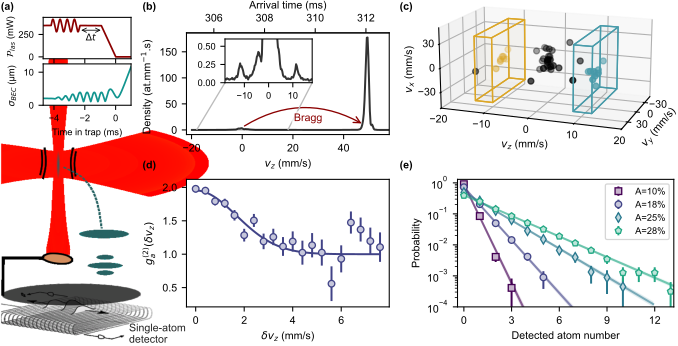
Figure 1.(a) Diagram of the experimental apparatus and excitation protocol. (b) The position and arrival time of individual atoms is recorded and converted to an initial velocity; sidebands are visible at ±11.7 mm/s. A Bragg diffraction pulse shifts more than 97% of the BEC atoms to later times to avoid saturating the detector near the excitations. (c) A single shot showing the excitations in 3D velocity space; each dot is a single atom, and the boxes show the position and size of a typical analysis volume, or “voxel”. (d) Auto-correlation function of the measured sideband velocities, giving an estimate of the longitudinal mode size and showing its thermal nature. (e) Probability distribution in a single voxel for different modulation depths A, each acquired over about 2800 realizations. The lines show the probability distribution of Eq. (3), computed from the mean detected atom numbers of 0.094(6), 0.37(1), 0.99(3), and 1.50(3) for increasing A.
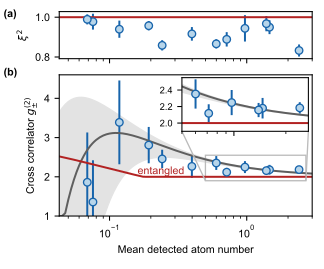
Figure 2.Normalized variance (a) and two-body correlator (b) as a function of the mean detected atom number, for modulation amplitudes between A=3 and 28%. The hold time Δt was fixed at 1.6 ms (3 breathing periods). The red line marks unity in (a) and the entanglement-witness threshold in (b), assuming a quantum efficiency of 25%. The gray curve is the expected value for a two-mode squeezed thermal state with an initial temperature of 25(5) nK and the same efficiency, its width reflecting the uncertainty on the temperature. Error bars denote one standard deviation, computed by bootstrap. ξ2 was not corrected for the quantum efficiency.
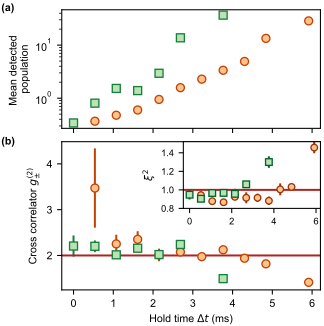
Figure 3.Mean detected population (a) and cross-correlation (b) as a function of the hold time Δt, for two modulation depths (orange circles, 18%; green squares, 25%). The inset shows the normalized variance. At late times, entanglement can no longer be inferred. Error bars denote one standard deviation, computed by bootstrap.
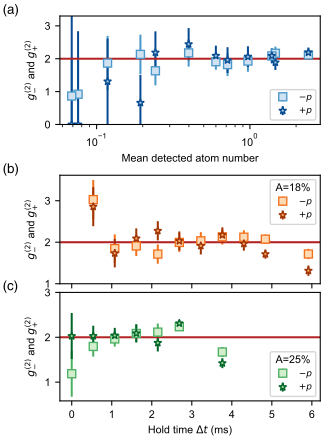
Figure 4.(a) The autocorrelator computed with the same dataset as in Fig. 2, in which we vary the modulation depth for a constant hold time. Panels (b) and (c) show the corresponding autocorrelator for the dataset of Fig. 3, where the hold time is varied with a modulation depth of respectively 18% and 25%. The light square markers show the negative velocity sideband and the dark stars the positive velocity one. The error bars are computed from the mean detected atom number and the number of realizations using Eq. (C2).
We have observed entanglement between parametrically excited quasiparticle
modes of a quantum fluid. This entanglement demonstrates the role of
quantum fluctuations in seeding the parametric growth, in analogy with
cosmological preheating. While it has its limitations, the relevance of the
analogy is strengthened by the late-time dynamics. As noted above, the
growing quasiparticle population leads to an interaction-dominated regime,
of which the apparent loss of entanglement in Fig. 3 may be an indicator.
This regime is characterized by a rich phenomenology, including decoherence
of the resonant modes, secondary peaks as observed in similar hydrodynamic
experiments, and loss of Gaussianity. These phenomena can be seen as steps
towards thermalization, and taken together they are analogous to
cosmological reheating. In addition, as the BEC keeps breathing, the energy
and coherence of the driving field will be lost to backreaction from the
produced quasiparticles, the effect of vacuum fluctuations playing again a
crucial role. Future work will investigate these effects.