We demonstrate the effect of pulse shaping in momentum selective atomic Bragg diffraction. We compare temporal square pulses, which produce sidelobes in momentum space, with other shapes which can produce more nearly square momentum distributions. We produce pulses that simultaneously address two sets of velocity classes and demonstrate that we can control the differential phase imprinted on them in a way that is insensitive to laser phase fluctuations. Our work marks a significant step forward in testing Bell inequalities using massive particles entangled in momentum.
Figures6
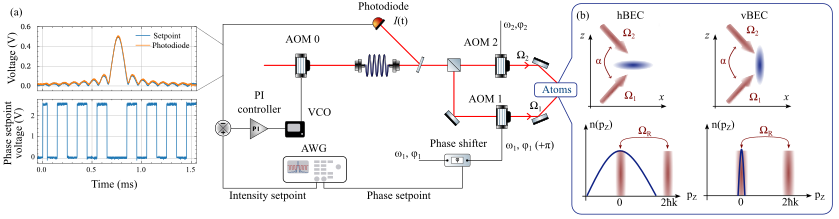
Figure 1.(a) Schematic diagram of the modulation technique to produce a sinc-shaped excitation. PI denotes Proportional Integral, VCO is Voltage-Controlled Oscillator and AWG Arbitrary Waveform Generator. The two plots show the waveforms used to produce a sinc excitation. The phase shifter used is a Mini-Circuits SPHSA-251+ component. Upper panel: intensity waveform produced by AOM 0. Lower panel: phase shift applied to AOM 1. 2.5 V corresponds to a π phase shift. (b) The hBEC is highly confined along the vertical direction, hence has a broad momentum distribution, much larger than the typical width of the Bragg pulses used here. Thus only a part of the distribution is transferred. The vBEC has a narrow distribution along z and thus acts as a spectroscopic probe of the laser pulse distribution.
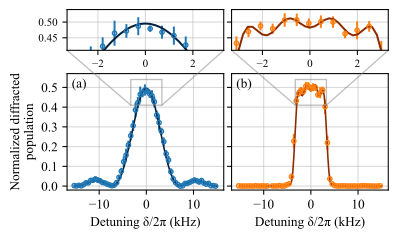
Figure 2.Experimental (dots) and theoretical (solid lines) transfer efficiency of a beam splitter for a square pulse (a) and a sinc pulse (b), where 1 kHz in detuning corresponds to 2 mm/s in velocity. The theoretical expectations are computed from the Schrödinger equation using the Hamiltonian given in Eq. (1), without any fit parameter, and integrated over a range of 1 kHz to account for the experimental binning range. Parameters are ΩM/2π=1.88 kHz, with durations of 133 μs and 1 ms respectively for the square and sinc pulses.
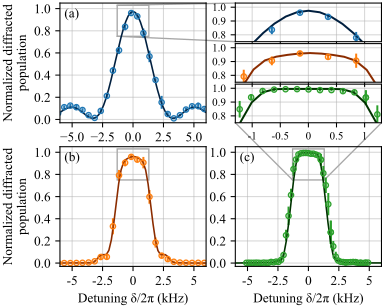
Figure 3.Experimental (dots) and theoretical (solid lines) transfer efficiency of a deflector for a square pulse (a), a sinc pulse (b), and a reburp pulse (c). The theoretical expectations are integrated over a range of 1 kHz to account for the experimental binning range. Parameters are ΩM/2π=1.88 kHz and a duration of 266 μs for the square pulse, ΩM/2π=2.05 kHz and a duration of 1.5 ms for the sinc pulse, and ΩM/2π=0.57 kHz and a duration of 1.8 ms for the reburp pulse. For the reburp pulse, all points in the interval [−0.5, 0.5] kHz are better than 98%.
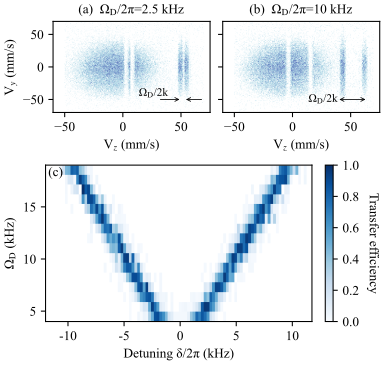
Figure 4.Effect of an overall modulation of the diffraction pulse. Two velocity doublets are selected by the same pulse (ΩM/2π=1.5 kHz, T=1.5 ms), and the separation is controlled by the modulation frequency ΩD. (a–b) A modulation frequency of ΩD/2π=2.5 kHz leads to a velocity difference of 5 mm/s in (a), while ΩD/2π=10 kHz leads to a velocity difference of 20 mm/s in (b). Data is averaged over 50 experimental runs with the hBEC. (c) The transfer efficiency of the vBEC (color scale) is shown as a function of the detuning; each slice is a different modulation frequency.
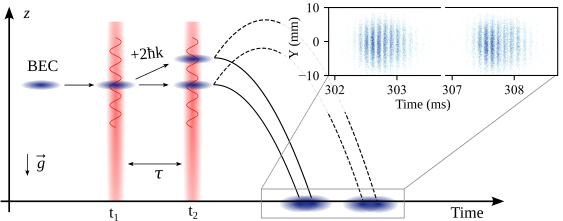
Figure 5.Diagram of the interferometer used to test the phase stability of the Bragg pulses. Two π/2 pulses create four falling clouds that interfere two by two when they overlap at the detector; the fringe period depends on the interferometer time τ. The inset displays fringes observed for τ=2 ms: the color encodes the density as a function of the arrival time T, defined in Eq. (11), and the horizontal position Y. Data is averaged over 25 repetitions — the good contrast confirms the stability of the phase difference over a duration of the order of τ.
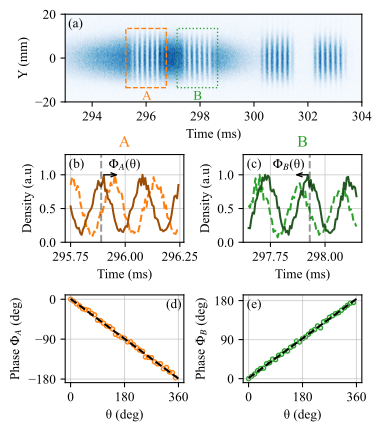
Figure 6.(a) Interference fringes from two parallel interferometers, produced by modulated π/2 pulses as in Eq. (9). Data averaged over 350 experimental runs, using a modulated sinc pulse with ΩM/2π=5 kHz, ΩD/2π=10 kHz, τ=4 ms. (b–c) Zoom on interference region A (b) and B (c), showing the fringes for a phase θ=0 (solid line) and θ=π/2 (dashed line); the phase of the interference pattern, defined in Eq. (11), shifts with θ. (d–e) Phase of the interference pattern as a function of θ, for region A (d) and region B (e). A linear fit yields slopes of −0.51(2) for A and +0.50(2) for B. The parameters used for these two plots are ΩM/2π=1.5 kHz, ΩD/2π=10 kHz, τ=1 ms.
We have demonstrated precise control over the reflectivity of Bragg
diffraction using shaped pulses. Our experimental setup provides access to
negative or even complex two-photon Rabi frequencies, thereby enhancing the
selectivity and reflectivity characteristics of Bragg transfers. For beam
splitters, a sinc pulse produces a square-shaped spectrum, while for
deflectors, a reburp pulse yields a more nearly square profile than a sinc
pulse. These pulses offer the advantage of being parameter-sparse and
easily adaptable to various experimental conditions.
By modulating a pulse with a cosine function, dual Bragg coupling with
resonances on two momentum doublets can be achieved. An interferometry
experiment further demonstrates fine control over the phase difference
imprinted between each momentum doublet, ensuring that this difference
remains, by design, independent of the phases of the lasers used. This is
of particular interest when trying to act differently on two momentum
classes that are very close spatially.